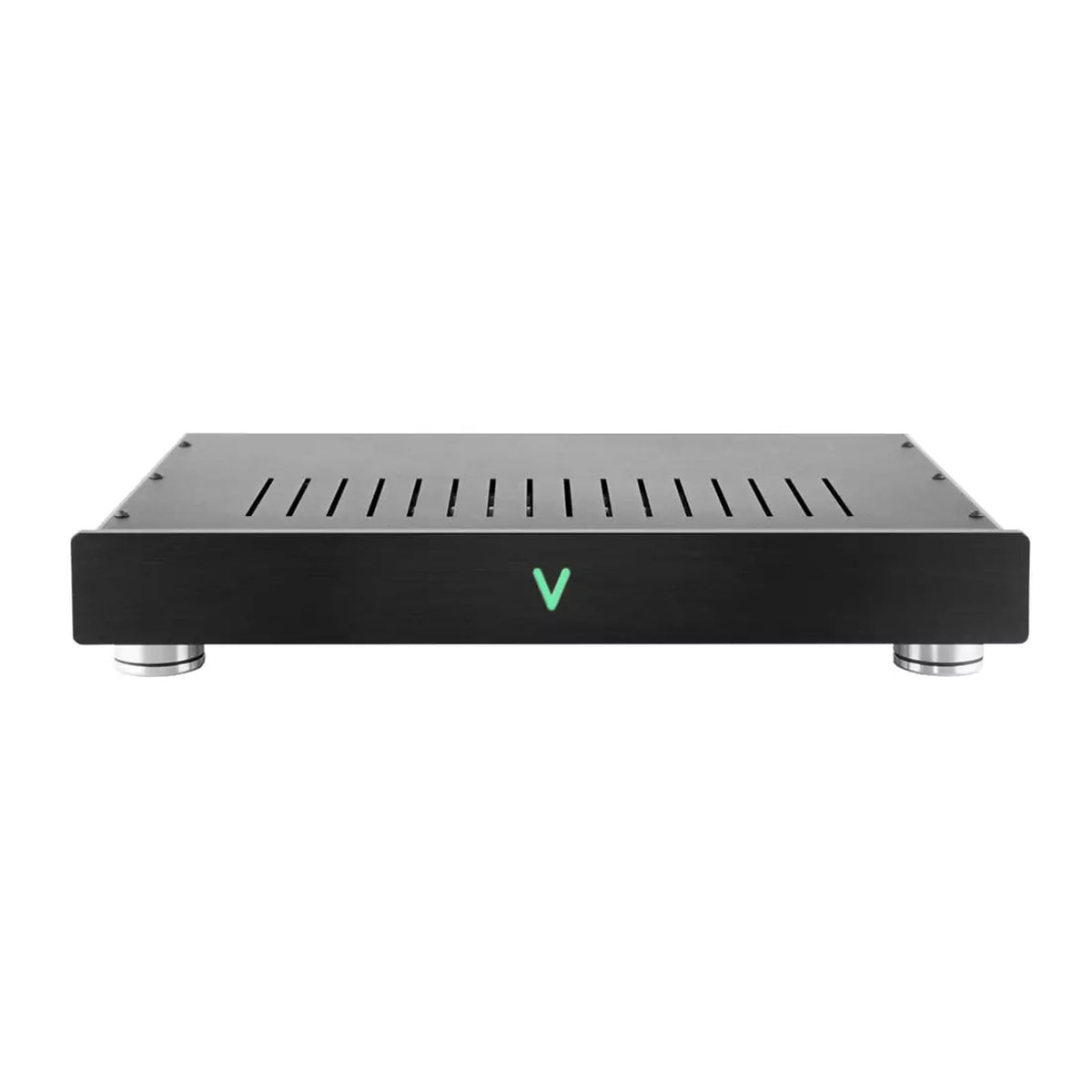
Valvet E3 Class-A Stereo Power Amplifier, Single-Ended
Valvet E3 Class-A Stereo Power Amplifier, Single-Ended
Couldn't load pickup availability
The Valvet E3 is a Class-A stereo power amplifier in single-ended design, combining both channels dual-mono in one chassis.
Single-ended Class-A is considered by amplifier purists one of the most demanding yet also most direct circuit topologies – a single transistor per channel handles the entire amplification, with no push-pull symmetry. Valvet implements this in the E3 with discrete operational amplifiers and skips every detour the signal doesn't need: short paths, pure silver wiring, a 500 VA toroidal transformer with separate windings per channel.
Why the Valvet E3?
Because it brings the single-ended philosophy into a stereo chassis, without you having to jump straight to two monoblocks. Dual-mono construction means: every channel has its own power supply segment, yet everything sits in one chassis. RCA and XLR inputs, WBT-NextGen speaker terminals and a carefully engineered aluminum housing (2–20 mm wall thickness) make it the more compact entry into Valvet's single-ended world.
What you hear
At 12 and 20 watts respectively, the E3 isn't a powerhouse, but that's exactly the point: single-ended Class-A circuits deliver little power but a very direct, harmonic midrange with fine resolution. Voices and acoustic instruments benefit the most – if you need loud levels or difficult speaker loads, the push-pull models A4.5 or A4e serve you better.
Who is the E3 suited for – and who isn't it for?
Straight talk: the E3 plays to its strengths on efficient speakers from about 89 dB upward – small, hard-to-drive compact speakers or electrostatics quickly hit the limit at 12 watts. If you listen at moderate room volume in a normal-sized room and have efficient speakers, you get a very direct, effortless sound in return. If you need more reserves, take a closer look at the A4.5 or A4e.
Our verdict
A compact entry into Valvet's single-ended Class-A world, without buying two monoblocks straight away. Tell us which speakers you have and how big your room is, and we'll tell you honestly whether 12/20 watts is enough or whether another Valvet model suits you better.
Technical data – Valvet E3
- Type: Class-A stereo power amplifier, single-ended, dual-mono
- Amplification principle: one transistor per channel, discrete operational amplifiers in Class A
- Power: 2 × 12 W into 8 Ω / 2 × 20 W into 4 Ω
- Gain: approx. 21 dB (up to 30 dB on request)
- Inputs: RCA (silver-plated) and XLR
- Input impedance: 50 kΩ
- Outputs: WBT-NextGen speaker terminals
- Power supply: 500 VA toroidal transformer with separate windings per channel
- Signal path: short, wired throughout in pure silver
- Housing: aluminum, 2–20 mm wall thickness, black anodized and powder-coated; front silver or black anodized, chrome only on explicit request
- Recommended speaker efficiency: from approx. 89 dB
- Feet: Alto Extremo
- Dimensions (W×H×D): 44.5 × 8 × 31 cm (incl. feet)
- Origin: handmade in Germany
Frequently asked questions
Which speakers suit the E3?
Best with models from about 89 dB efficiency upward. At 12 and 20 watts respectively, the E3 isn't an amplifier for large rooms, but on suitable speakers it plays very directly and effortlessly.
What does "single-ended Class-A" mean in the E3?
A single transistor per channel handles the entire amplification, with no push-pull symmetry. That limits output power but is considered by connoisseurs a particularly direct, low-distortion design in the small-signal domain.
Can I drive the E3 balanced (XLR)?
Yes, alongside the RCA inputs the E3 also has XLR inputs. Input impedance is 50 kΩ regardless of which input you use.
How does the E3 differ from the mono model E4?
The E3 combines both channels dual-mono in one chassis, the E4 comes as a pair of true monoblocks each with its own power supply. Sonically both follow the same single-ended principle; the E4 offers even more consistent channel separation thanks to the complete galvanic isolation of the channels.
Why buy the Valvet E3 at HD Zürisee?
Because a single-ended power amplifier only shows its potential on the right speakers. We advise you in Wädenswil on your speakers' efficiency and the matching preamp, and install the system with our own technician if needed.
Goes well with: matching preamplifiers, efficient bookshelf speakers and the right cables.
Share