

Gold Note DS-1000 EVO Streaming DAC, Gold
Gold Note DS-1000 EVO Streaming DAC, Gold
Price per Stück
Couldn't load pickup availability
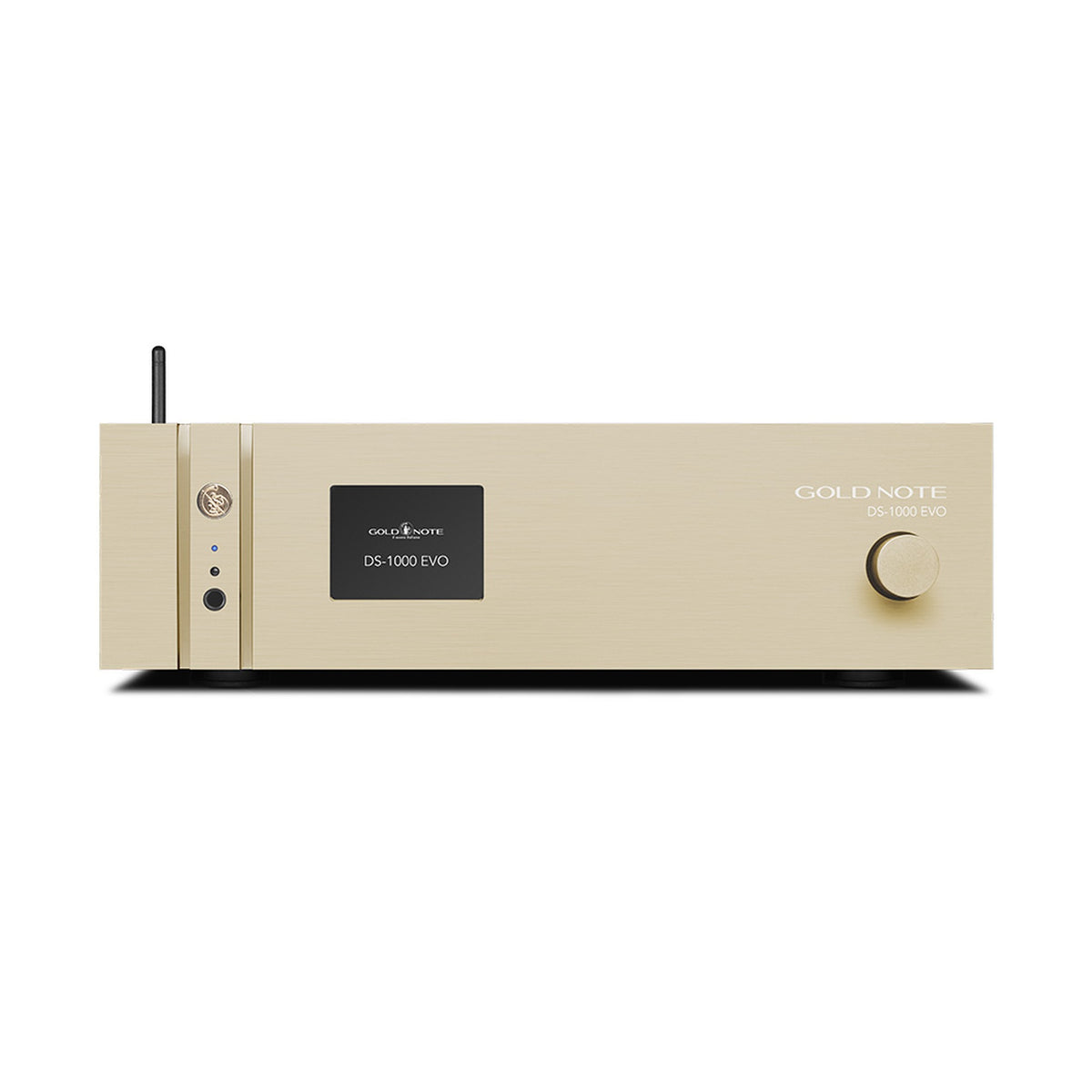
The Gold Note DS-1000 EVO is a streaming DAC that combines a network player, two AKM AK4493 converters in a dual-mono layout and a Class A output stage in one full-size chassis. This version comes in Gold, made of brushed and anodised aluminium. Gold Note from Tuscany calls it the most advanced streaming DAC the company has ever built – a confident claim that the DS-1000 EVO lives up to with remarkable composure.
Why the DS-1000 EVO?
Because it has a clear job and does it without detours: fetching music from the network, the computer or a USB stick and passing it on to your amplifier as a clean analogue signal. The outputs deliver a fixed 2 Vrms via RCA and XLR – so it is a pure streamer and converter, not a preamp. If you already own a good integrated amplifier or preamplifier, you pay for nothing twice here. And if you want more later, you can add an external power supply (PSU-1000 or PSU-1250) or a tube output stage (TUBE-1006 or TUBE-1012). A component that grows with you instead of ending up in a classified ad after three years.
What you hear
Gold Note cultivates a warm, flowing sound that the Italians themselves call «Italian Sound» – plenty of body, natural timbres, nothing harsh. Dual-mono conversion with one AK4493 per channel ensures clean channel separation and a stable soundstage. It handles high-resolution files up to PCM 32-bit/384 kHz and DSD512 via USB. Streaming runs via Roon Ready, AirPlay, Tidal Connect, Spotify Connect, Qobuz and Deezer – or without any subscription via internet radio (vTuner), your music collection on a NAS via UPnP/DLNA or a USB stick at the front. You control it with the remote or the GN Control app.
Who is the DS-1000 EVO for?
For anyone who owns an amplifier they want to keep and is looking for a digital source that plays at the same level. It fits especially well in a Gold Note chain built around the P-1000 MKII Deluxe. Bottom line: if you want to drive a power amp or active speakers directly, this is the wrong device – it has no volume control. That is what the DS-1000 EVO Line with its built-in Class A preamp is for. And if you only play the odd playlist in the background, a smaller streamer is the more honest choice.
Our verdict
The DS-1000 EVO is a grown-up streaming DAC without gimmicks: consistently engineered, sonically on the musical side and with a real upgrade path. At HD Zürisee in Wädenswil we are happy to work out with you whether it suits your amplifier or whether the Line version is the smarter choice.
Technical data
- Type: streaming DAC (network player with D/A converter)
- Finish: Gold, brushed anodised aluminium
- D/A converter: 2× AKM AK4493, dual mono
- Output stage: Class A
- Resolution: PCM up to 32-bit/384 kHz, DSD up to DSD512 (USB)
- Streaming: Roon Ready, AirPlay, Tidal Connect, Spotify Connect, Qobuz, Deezer, vTuner, UPnP/DLNA
- Network: LAN, Wi-Fi (802.11 a/b/g/n/ac), Bluetooth 5.0
- Digital inputs: 1× coaxial (RCA), 1× AES/EBU, 2× Toslink (each up to 24-bit/192 kHz), 1× USB-B (asynchronous), 1× USB-A (front)
- Analogue inputs: none
- Analogue outputs: 1× RCA, 1× XLR
- Output level: fixed, 2 Vrms (no volume control)
- Headphone output: yes, 6.3 mm jack (front), High/Low sensitivity
- Output impedance: 50 Ω (RCA), 100 Ω (XLR)
- Frequency response: 20 Hz – 20 kHz (±0.1 dB)
- Distortion: max. 0.001 %
- Signal-to-noise ratio: 125 dB
- Dynamic range: 120 dB
- Upgrades (sold separately): external power supply PSU-1000/PSU-1250, tube output stage TUBE-1006/TUBE-1012
- Operation: colour display, remote control, GN Control app (iOS/Android)
- Dimensions (W × H × D): 430 × 135 × 375 mm
- Weight: 10 kg
- Scope of delivery: DS-1000 EVO, multifunction remote control
Frequently asked questions
Does the Gold Note DS-1000 EVO have volume control?
No, the DS-1000 EVO has fixed outputs at 2 Vrms on RCA and XLR. It therefore needs an integrated amplifier or a preamp after it. If you want to drive a power amp or active speakers directly, the DS-1000 EVO Line with its built-in analogue Class A preamp is the right choice.
What is the difference between the DS-1000 EVO and the DS-1000 EVO Line?
The Line version adds an analogue Class A preamp with volume control as well as one analogue RCA and one XLR input. Converters, streaming, digital inputs and chassis are the same on both. The DS-1000 EVO is the pure streaming DAC for anyone who already has a preamp or an integrated amplifier.
Do I need a streaming subscription for the DS-1000 EVO?
No, a subscription is an option, not a requirement. Without any running costs you can play internet radio via vTuner, music from your NAS via UPnP/DLNA, files from a USB stick at the front or music from your computer via USB. You can add Qobuz, Tidal, Spotify or Deezer at any time if you like.
Can I connect headphones to the DS-1000 EVO?
Yes, there is a 6.3 mm headphone output at the front with switchable sensitivity (High/Low) for easy-to-drive and more demanding models. That is perfectly fine for listening in the evening. If you run very demanding headphones, a separate headphone amplifier gives you extra reserves. That way the living room stays quiet while you finish one more album late at night.
Why buy the Gold Note DS-1000 EVO at HD Zürisee?
Because we send you more than a parcel: we work out with you whether the DS-1000 EVO suits your amplifier and your speakers, whether the Line version would make more sense and how to get it cleanly onto your network. On request, our own technician takes care of delivery, installation and setup at your home.
Goes well with
- Integrated amplifiers – the DS-1000 EVO needs a partner with a volume control; you will find it here.
- Preamplifiers – for separate chains with a power amp.
- Power supplies – the clean first step for a later upgrade.
- XLR cables – so the balanced outputs are not held back by the wire.
Share
A great match for this device
Studio-quality music – try Qobuz free for 60 days

This device plays Qobuz natively – up to 24 bit/192 kHz, lossless. Find out what the service offers, who it is for and how to try it free for 60 days:
More about Qobuz →