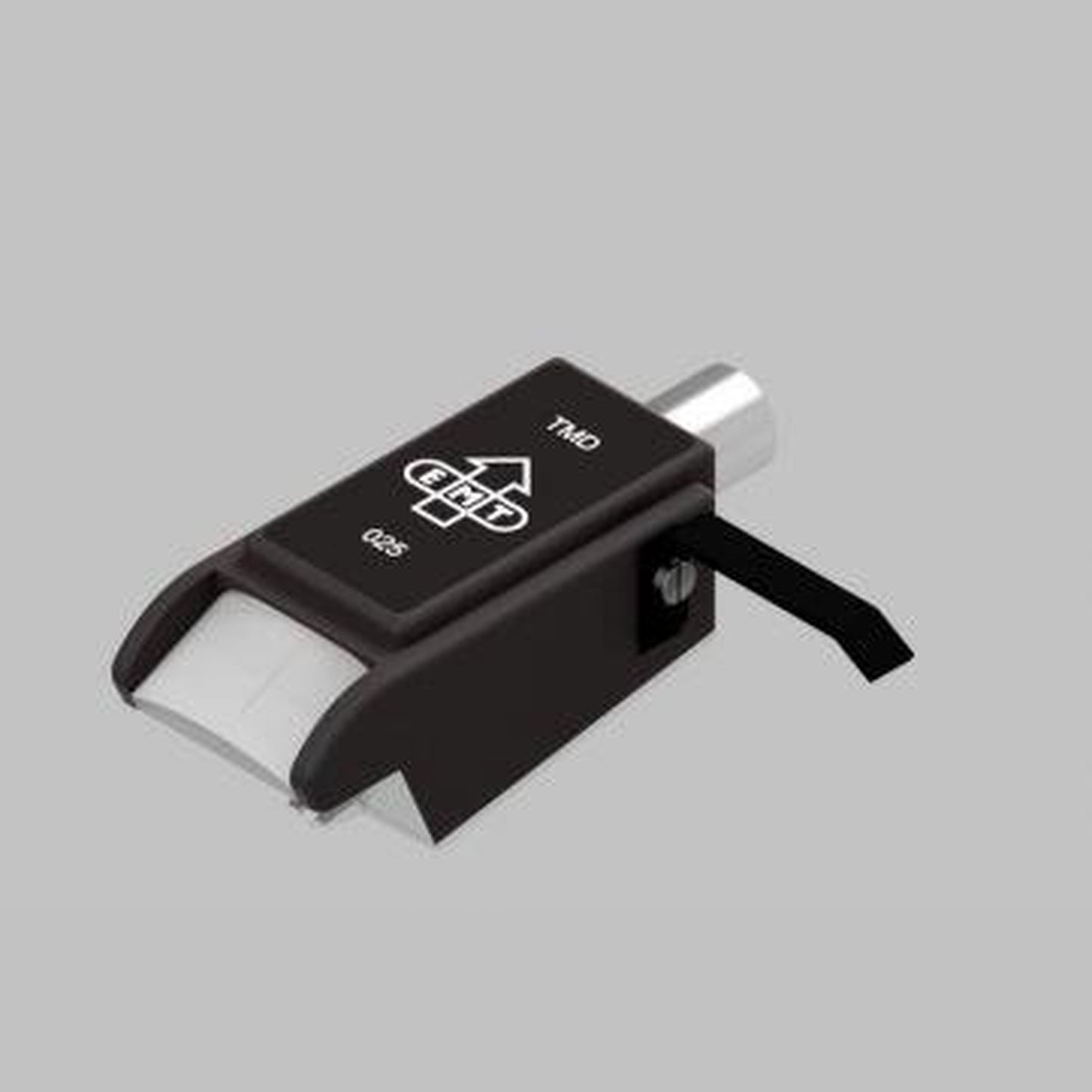
EMT TMD 025 Cartridge, Mono MC with 25 µm Diamond
EMT TMD 025 Cartridge, Mono MC with 25 µm Diamond
Couldn't load pickup availability
The EMT TMD 025 cartridge is a true mono phono cartridge in the EMT cartridge housing, whose spherical 25 µm diamond is designed for the wider grooves of older mono records.
Ten micrometers sound like nothing. In a record groove, they're the difference between "sort of tracking" and "properly seated." That's exactly why this cartridge exists alongside its 15 µm sibling — not as a shelf variant, but as an answer to a different cutting generation.
Why the TMD 025?
Mono pressings from the 1950s and early 1960s were cut with wider grooves than what comes off the press today. A fine, modern radius dives too deep into a groove like that. Down there, two things collect: dirt that no brush has ever reached, and the wear of six decades of playback history with styli that nobody today would wish on anyone.
The 25 µm diamond simply engages higher up, on a flank that doesn't carry this history. That's not sonic cosmetics, it's geometry. The rest of the cartridge stays identical to the TMD 015: the same EMT generator from broadcast heritage, the same monoblock milled from solid magnesium, the same true mono conversion without a vertical channel.
What you get
Above all, a quieter foundation. Where there used to be a background noise you took for "that's just how an old record sounds," surprisingly little often remains. Voices and horns stand closer together, piano attacks lose the slight blur that no equalizer ever managed to remove.
And you get headroom: 1.05 mV at 5 cm/s is plenty for an MC system, which benefits the quiet passages of historical recordings.
Who is the TMD 025 for?
For you, if your mono collection is mainly from the 1950s and early 1960s, or comes second-hand and has been played accordingly hard. A prerequisite is a tonearm with EMT, Ortofon A or SME mount that comfortably carries 17.5 g.
Honestly: for mostly modern mono reissues it would be the wrong choice — there, the TMD 015 reads more information out of the groove. It's not made for stereo records either way, and for shellac its radius is far too small; that's the TND 065's territory. If you only have three mono records in the cabinet, you'd invest the money better in the phono stage.
Our verdict
A specialist you only appreciate once you know the alternative. For archives, estates and grown collections, the larger radius isn't a detail, it's the actual reason the records become enjoyable again. At HD Zürisee in Wädenswil, we clarify with you upfront how your collection is made up — the radius question usually answers itself from that.
Technical data
- Diamond: spherical, rounding radius 25 µm (SPH 25 µm)
- Frequency response: 20 – 18,000 Hz (±2 dB); 40 – 12,500 Hz
- Type: MC cartridge, true mono (True Mono)
- Cantilever: Aluminum
- Body: Cartridge, monoblock milled from solid magnesium
- Vertical tracking angle (VTA): 23°
- Recommended tracking force: 2.5 g
- Output voltage: 0.21 mVs/cm (equivalent to 1.05 mV at 5 cm/s)
- Compliance: 12 µm/mN
- Internal resistance: 24 Ohm
- Recommended load impedance: 200 – 300 Ohm
- Weight: 17.5 g
- Connection/mount: EMT standard; optional INT (Ortofon A) or X (SME)
- On request: silver coils as well as 1/2 and 1/4 coil versions
Frequently asked questions
How does the TMD 025 differ from the TMD 015?
In the diamond's rounding radius: 25 µm instead of 15 µm. The larger radius sits higher in the groove and thus matches the wider grooves of older mono pressings. Otherwise both cartridges are identical in construction — same generator, same magnesium monoblock, same electrical specs, same 2.5 g tracking force.
Which records benefit from 25 µm?
Mono LPs from the 1950s and early 1960s, as well as pressings from the transition period between shellac and vinyl. Their grooves were cut wider than is common today. A modern 15 µm diamond dives too deep there and reads exactly the zone of the groove that is most worn.
Does a larger diamond protect my old records?
It tracks a different area of the groove flank than a smaller radius. On well-played older stock, wear usually sits low and central — exactly where a fine radius operates. The 25 µm diamond avoids that zone and therefore often delivers the quieter result.
How do I connect the TMD 025?
Mechanically via the cartridge's standard EMT connection, or alternatively in the INT variant for Ortofon A tonearms or X for the SME standard. Electrically it needs an MC input with 200 to 300 Ohm load impedance; internal resistance is 24 Ohm, recommended tracking force is 2.5 g and weight is 17.5 g.
Why buy the EMT TMD 025 cartridge at HD Zürisee?
Because choosing the right rounding radius takes experience, not brochure knowledge. We've been looking after collections since the early days of our shop and work out together with you which radius suits your holdings. Our technician handles installation and setup — reach us by phone, WhatsApp or email.
Goes well with
Old pressings reward care on both ends: under Plattenspieler-Zubehör you'll find what keeps the groove clean, under Phono-Vorverstärker the right MC matching. For an overview of everything related to records, see Alles Vinyl, more cartridges are listed under Tonabnehmer.
Share